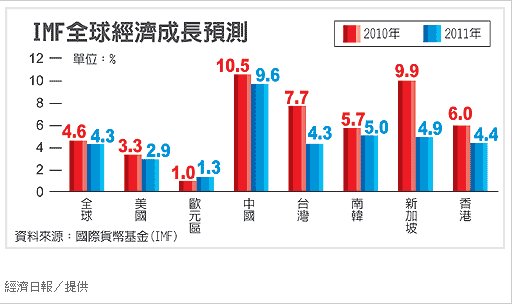
The end of the boom is now in sight, and the ripple effects of slower growth will span the globe.
The way the global economy begins a decade reveals little about how it will end. In 2000, the Anglo-Saxon economic model was ascendant and the tech revolution was sweeping the globe. Emerging nations were a mere sideshow to the great Wall Street carnival, attracting less than 5 percent of the money in global stock markets. A decade earlier, the spotlight was trained on Japan , a star that had redefined the global economic stage in the 1980s. As late as the 1992 U.S. presidential campaign, one candidate reviewed the performance this way: “The Cold War is over and Japan has won.” Today, Japan is widely viewed as a washout, and all admiring eyes are on the boom in China , a force so powerful it has lifted the performance of many other economies. Resource-rich countries like Brazil and Australia have achieved global economic acclaim, mainly by selling iron ore, copper, and other commodities to feed the construction spectacle in China . Many big-name investors believe the China boom is set to continue, driven by investment spending. Investment now represents 45 percent of the Chinese economy, a level that is historically unprecedented, both in China and in any major economy. Yet China has been able to maintain this rate of spending for several years in a row, mainly because it has been industrializing a largely rural economy. With many laborers still available to move to new factories in manufacturing boomtowns, the government could keep pouring money into highways and factories. Analysts expected that the global recession of 2008 would cut demand for Chinese exports and drag the economy down. Exports did drop sharply, but the Chinese leadership launched a massive stimulus plan, centered around yet more infrastructure spending, extending the investment boom, and keeping economic growth above the long-cherished annual goal of at least 8 percent.
Now, however, evidence is mounting that China’s growth “miracle” is on the verge of a major slowdown, which could bring the 10 percent growth rate of recent decades down to 6 or 7 percent in coming years. Recent high-profile labor strikes have dramatically called into question the China model, built on cheap labor and exports. And the rate of growth in spending is about to slow, because there are only so many new highways, railways, and ports China can build, and because land and labor costs are rising sharply. Government targets for spending in all these areas are shrinking; the mainland already has more than 65,000 kilometers of highways, the second-largest network behind the United States’ 80,000-plus kilometers. After adding more than 6,000 kilometers in 2008 and 8,000 kilometers in 2007, China’s ministry of transportation plans to construct only 5,000 kilometers of new highways per year from 2010 onward. Spending on railways is also likely to peak this year. In the wake of the financial crisis, banks are also facing greater credit controls and higher reserve requirements, which will further slow investment.
So the story of the coming decade could well be that China runs out of growth drivers. Those who believe the economy can keep growing at close to double-digit rates often argue that it can do this by replacing investment with consumer spending, and exports with domestic sales. This would rebalance the economy not only of China but also of the world, giving struggling Western economies more opportunity to sell to Chinese consumers. But this hope is built on a big myth, namely that China has deliberately prevented the emergence of a consumer economy. For the last 30 years now, Chinese consumer spending has increased at a robust inflation-adjusted rate of nearly 9 percent a year. For it to grow any faster would defy the history of economic development, in a dangerous way.
The myth of China’s slow-growth consumer economy is built on misleading data. Consumer spending did fall as a share of the economy in 2008 to a record low of 36 percent but only because growth in investment spending was much higher than growth in consumption. This is typical of rapidly industrializing economies; during their decades of “miracle” growth, Japan and Taiwan had a similar profile, though China is even more dependent on investment spending and exports. Consumer spending in Japan and Taiwan never grew faster than 10 percent a year, and it’s not likely to accelerate much faster in China .
Now China appears to be reaching a critical turning point, at which it has become too big to continue growing so rapidly. When Japan’s per capita income in the mid-70s reached levels similar to those of China today ($ 4,000 in current dollar terms), investment spending slowed down markedly and so did the economy’s overall growth rate from a trend rate of 9 percent to 5 percent.
There are big differences, of course. Only 46 percent of China’s population lives in cities, compared with 55 percent in mid-70s Japan , leaving more room to grow through urbanization. Still, the trend line is clear. Though exports have rebounded in 2010, there are limits to future growth, as China is already the world’s largest exporter with a 10 percent share of the global market. Eventually, China will be forced to revalue its currency, as Washington would very much like it to, and that will make exports less competitive, increasing the consumption share of the economy, with slower growth the natural result.
The unrest among Chinese workers will only fuel this trend. The bargaining power of labor will increase, in part because tight enforcement of the one-child policy is shrinking the size of the workforce. Only 5 million people age 35 to 54 will join China’s core labor force this decade, versus 90 million in the previous decade. Wages will have to rise a lot faster to compensate for the fall in the growth rate of labor. That will mean a more balanced domestic economy, but it also will mean that low-end, high-growth manufacturing will continue to migrate to cheaper parts of Asia and Africa .
That’s not necessarily a bad thing, as far as the Chinese leadership is concerned. Outsiders who think Chinese policymakers care only about fast growth miss the growing focus on social stability, and concern about how quickly the labor market tightened and inflation surfaced after the downturn. Property prices have rocketed in the major cities as the more cash-rich Chinese have been buying multiple homes, encouraged by the very low cost of borrowing. After doubling between 2003 and 2008, property prices in premier cities rose by more than 30 percent on average over the past 12 months, making houses increasingly unaffordable for the vast majority. The most popular television show these days is Woju, or “Snail’s Home,” which depicts the despair of average Chinese people amid spiraling apartment prices. To get developers to cut back prices, the government is cracking down hard, increasing minimum down-payment requirements and suspending lending for some new projects. Given that property constitutes a third of all investment spending in China , growth will inevitably slow.
Ironically, the Chinese are far more open and honest about the growth challenges they face than outsiders are. One good indicator of this phenomena is that China’s stock market, still largely closed to outsiders, has been drifting lower for months, retracing its way to levels seen a year ago. But across the world, “China plays,” or investments that assume a continued boom in China , kept rallying through April, and today remain much higher than they were a year ago. Those plays range from currencies of major commodity-exporting nations to various materials stocks. At a recent China conference, a leading mining-company executive compared talk of China slowing from 10 percent to 6 percent growth to speculation about a train hitting someone at 100 or 70 kilometers an hour. The end result is the same, he argued.
Nothing could be further from the truth. Slower growth in China could, for example, upend the world of commodity producers. In 2000, they were investing very little following a 20-year secular decline in commodity prices, and hardly anyone foresaw the coming boom in demand from China . When it arrived, unexpected, the spike in prices lead to windfall profits. Now producers of commodities from iron ore to oil and copper have been adding capacity based largely on expected demand from China that may not materialize.
A slowdown in China could shock the star economies of the past decade, including Australia and Brazil . China accounts for 30 to 60 percent of global demand for most industrial commodities, and commodity exports account for 64 percent of exports from Australia , 55 percent from Brazil . Today the fundamentals look great in Brazil and Australia , but every country always looks best at its peak. Australia , now more than ever, considers itself the “Lucky Country,” as mining metals for China generates jobs and investment. Brazil expects blowout growth of 7 to 8 percent this year, making it a current darling of global investors. Both Australia and Brazil are running current account deficits, suggesting they have saved little of the windfall from recent commodity sales and expect no end to the China boom. They are far from alone. Rising demand from China has accounted for nearly half the jump in global oil demand over the past decade, and the assumption that oil prices will keep rising underpins the budget outlays of countries from Russia to Venezuela . A slowdown in China could change all this in a flash.
For investors, the time has come to think of a world beyond “China plays.” At one level, this implies looking at markets in China that may grow even if the economy slows. One example could be PCs and LCD TVs, for which there is still wide, unmet demand. At another level, it means looking at commodity-importing countries that could benefit from a decline in prices, like India and Brazil . A decline in commodity prices would ease inflationary pressures that can be one of the major obstacles to growth in these nations.
No one gains if the slowdown comes hard and fast, and some China bears think it will, given the scale of the boom and the related credit excesses. One commentator compares China’s possible fall below the 8 percent official growth target to the Hollywood thriller Speed, in which a bomb on a bus is set to detonate if the vehicle slows to below 50 miles an hour. In China , the bomb would be triggered by the slump in job creation and explode in the form of labor unrest.
The current debate on China’s future has just two camps, the extremely bullish majority and a very shrill, bearish minority, but the truth may lie in the middle. China could well be like Japan in the mid-1970s, a period when Japan began to downshift, but remained a compelling growth story for 15 years. China’s share of global economic output has more than doubled in the last decade, but is still just 8.5 percent. If China moves smoothly to 6 or 7 percent growth in the coming years, it will hardly be a cataclysmic event, except possibly for those who have bet it all on the story of the last decade.
Sharma is head of emerging markets at Morgan Stanley investment management.
1. Nat Bellocchi白樂崎〔前美國在台協會主席﹞ 2. Coen Blaauw昆布勞﹝美國台灣人公共事務會 ﹞ 3. Gordon G. Chang 章家敦﹝「即將崩潰的中國」作者﹞ 4. Peter Chow周鉅原﹝美國紐約市立學院經濟學教授﹞ 5. Stephane Corcuff﹝法國里昂大學「中國和台灣研究」政治學副教授﹞ 6. Michael Danielsen﹝丹麥哥本哈根「台灣一角」主席 ﹞ 7. June Teufel Dreyer金德芳﹝美國邁阿密大學政治學教授﹞ 8. Norman W. Getsinger, 美國外交人員 (已退休), 華府喬治華盛頓大學研究 9. Terri Giles賈泰麗﹝美國福爾摩莎基金會執行長﹞ 10. Michael Rand Hoare﹝英國倫敦大學退休副教授﹞ 11. Thomas G. Hughes ﹝美國前參議員斐爾國會辦公室主任﹞ 12. Richard C. Kagan柯耕義﹝美國翰林大學教授歷史系退休教授﹞ 13. Jerome F. Keating祈潤夫﹝國立台北大學副教授(已退休)﹞ 14. David Kilgour﹝加拿大前國會議員、亞太國務卿﹞ 15. André Laliberté﹝加拿大渥太華大學政治學副教授﹞ 16. Daniel Lynch ﹝美國南加州大學副教授﹞ 17. Victor H. Mair﹝美國賓夕法尼亞大學中國語言和文學系教授﹞ 18. Donald Rodgers﹝美國德州奧斯汀大學政治學副教授﹞ 19. Terence C. Russell, 加拿大曼尼托巴大學﹐亞洲研究中心中文副教授 20. Christian Schafferer﹝僑光科技大學國際貿易系副教授,奧地利東亞研究協會主任,「當代東亞」主編﹞ 21. Michael Stainton﹝加拿大多倫多York Center for Asia Research﹞ 22. Peter Tague﹝美國喬治城大學法律系教授﹞ 23. John Tkacik譚慎格﹝前美國傳統基金會資深研究員及前美國務院台灣事務協調處官員﹞ 24. Arthur Waldron林蔚﹝美國賓夕法尼亞大學國際關係學教授﹞ 25. Vincent Wei-cheng Wang王維正﹝美國里奇蒙大學政治學教授﹞ 26. Gerrit van der Wees韋傑理﹝台灣公報編輯﹞ 27. Michael Yahuda, Professor Emeritus, London School of Economics and Visiting scholar, George Washington University〔英國倫敦經政學院退休教授, 美國華府喬治華盛頓大學訪問學者〕 28. Stephen Yates葉望輝 ﹝ DC Asia諮詢顧問團總裁,前美國副總統國家安全政策顧問﹞
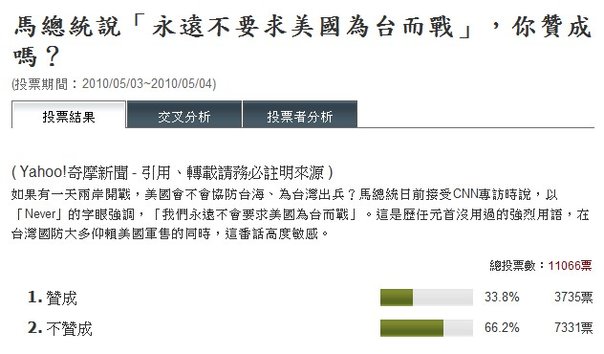
馬英九接受CNN專訪時表示,「我們將永不要求美國為台灣而戰 (We will never ask the Americans to fight for Taiwan)」,著實令大家感覺「毛毛的」!雅虎奇摩上的民調則顯示,六成六以上的網民不認同馬的說法。台灣現在的戰力遠遠落後於中國,中國也從未放棄以武力併吞台灣,其對台灣安全威脅最具體的例子,就是中國在對岸安排對準台灣的超過一千五百枚飛彈,並不時武嚇台灣,統一台灣的目標根本都沒有改變。馬憑什麼說這句話?
仔細看CNN訪問影片(見以下影片),原來是馬的自我感覺良好,以為近兩年跟中國簽了不少協議,即可減少兩岸緊張;並自詡這兩年與中共關係的改善,遠比過去六十多年來、美國以兵力維持區域平衡來得有效,因此在受訪中以「We didn't ask the U.S. to get involved in the warfare with mainland China」(PartII,3'15")及「We will never ask the Americans to fight for Taiwan」(PartII,6'25"),兩度表明不再需要美國的援助,且以「this is something that is very very clear」(PartII,6'30"),來強調這個主張。由此得知,馬回答向美國軍購,也不過是敷衍之辭。馬這些話等於呈現,其跟中國已經有了密室內的政治交易!如2008年8月提出兩區說,確保陳雲林來台;以及2009年10月提出「一中原則為前提的一中各表」,以換取中方ECFA的配合。
MA: Well as I've said, at the moment the risk for the United States is the lowest in 60 years. In the past, actual the risk was much higher but as a result of our efforts to have [inaudible] with the Chinese mainland, the tension has been greatly reduced. That is why the current administration, like previous administrations, is very pleased what happen in the last two year and we will continue to reduce the risk so that we will purchase arms from the United States but we will never ask the American to fight for Taiwan. This is something that is very, very clear.
按:根本是鬼話連篇!馬政府什麼時候針對網路自由提出意見?君不見 Google 退出中國一事,所有的統派媒體一味地報導 Google 將喪失多少商機,全都是負面報導。馬政府什麼時候跟中國提過網路自由?相對地,台灣的網路與新聞自由還在逐漸地限縮當中,台灣的新聞自由度從民進黨執政的全球 23 名,退步到現在的 47 名。ㄟ,請問一下馬先生對這件事有什麼看法啊?
Also of note was the influence of owners over the editorial content of media they acquire. After Tsai Eng-Meng, a businessman with significant commercial interests in the PRC purchased the China Times Group in November 2008, a series of incidents in 2009—including Tsai’s own comments to the media—pointed to a subsequent change in editorial policy in the direction of softening criticism of the Ma administration, Beijing, or improvements in cross-strait ties. This also raised concerns over the potential direct or indirect influence of the Chinese government on free expression in Taiwan.






 李登輝在626遊行高呼「棄馬保台」,馬上引起了國民黨府院黨一致的撻伐,其中以吳敦義的叫囂最引人注目,他重批兩位前任總統,「李登輝與陳水扁,一個把台灣做壞、一個把台灣做糟,過去都沒做好,現在馬總統認真做反而被怨恨,他反問,這公平嗎?」